How to Select the Right Insert for Your EVA Case?
How to Select the Right Insert for Your EVA Case?
5/3/20262 min read
Guide: How to Select the Right Insert for Your EVA Case?
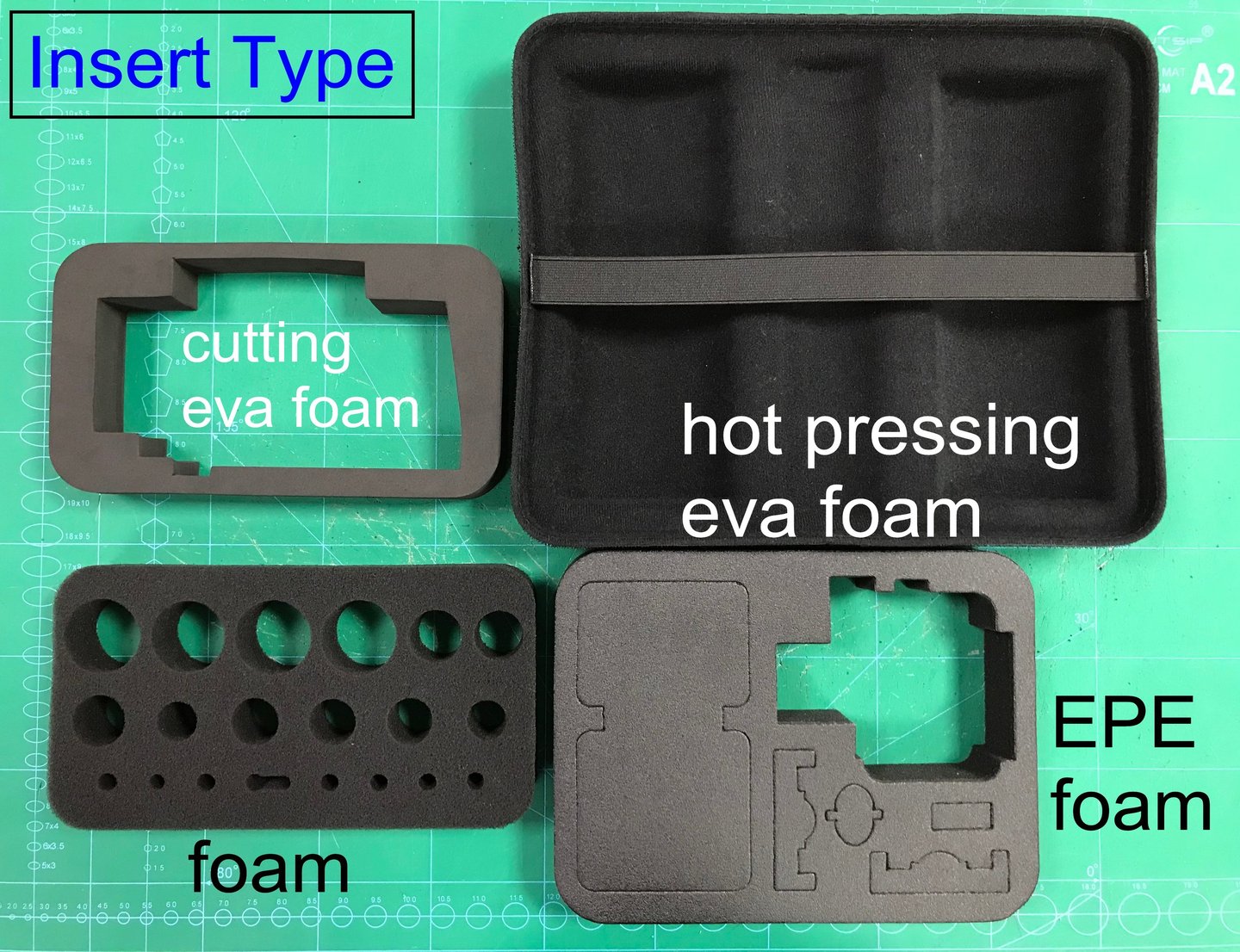
EVA cases generally offer four primary types of internal inserts. Choosing the right one depends on your product's requirements, brand positioning, and budget.
1. Hot Pessing EVA Foam Inserts (Premium Fit & Protection)
This is the optimal choice for those seeking a high-end presentation and a "perfect fit" for their products.
Manufacturing: Requires specialized precision molds, which involves a higher initial cost.
Key Features: Allows for 1:1 precision molding based on the product’s shape, achieving a seamless, snug fit. It can accommodate complex 3D contours and curved geometries.
Performance: Compared to standard foam, thermoformed EVA has a higher density, providing superior shock absorption and cushioning.
Applications: Commonly used for high-precision instruments such as massage guns (fascia guns), drones, remote controllers, and medical devices like stethoscopes.
2. Die-Cut EVA Inserts (Structural Durability & Precision)
Ideal for products requiring strong structural support and long-term durability with relatively regular outlines.
Manufacturing: These inserts are typically carved via CNC or cut using a die, then layered and bonded before being secured into the case's bottom cover.
Key Features: No physical product sample is required for development—only a 3D design file. These inserts usually feature vertical or stepped profiles.
Performance: High density with a fine, smooth surface for a premium feel. They are exceptionally tough, wear-resistant, and corrosion-resistant, making them suitable for repeated, long-term use.
Applications: Used for microphones, audio interfaces, portable coffee machines, professional cameras, automotive parts, and luxury wine packaging.
3. Die-Cut Pearl Cotton (EPE) Inserts (Cost-Effective Logistics)
The go-to solution for large-scale shipping where cost efficiency and lightweight materials are priorities.
Manufacturing: Produced through die-cutting, slitting, or shaped-bonding processes; requires a standard cutting die.
Key Features: Lighter and more affordable than EVA, making it ideal for mass-market logistics.
Performance: Offers excellent cushioning and vibration resistance. However, it is prone to tearing or deformation over time, and its resilience decreases with repeated use.
Applications: Widely used for laptops, monitors, printers, glass/ceramic ornaments, jade collections, and bulk shipments of high-end wine or spirits.
4. Die-Cut Sponge/Foam Inserts (Softness & Scratch Prevention)
Best suited for lightweight, fragile, or surface-sensitive products that require a gentle touch.
Manufacturing: Fabricated via die-cutting or specialized contour cutting; requires a cutting die.
Key Features: Known for exceptional softness, high elasticity, and breathability.
Performance: Provides a softer interface than the rigid EVA or EPE, making it perfect for protecting items highly sensitive to surface scratches.
Applications: Ideal for perfumes, optical lenses, anti-static chips, luxury lighters, pens, watches, jewelry, medical ampoules, and Hi-Fi headphones.
Cost Analysis Summary
The total investment varies significantly across these four options:
Hot Pessing EVA Foam: Highest cost (due to specialized tooling).
Die-Cut EVA Foam: Moderate cost.
Die-Cut Sponge/Foam: Low-to-moderate cost.
Die-Cut EPE Foam(Pearl Cotton): Lowest cost.
Xinhejin Industry (Guangdong) Co., Ltd
18 years china cosmetic bags factory.
Contact
Email: info@xhjbags.com
Mob/Whatsup: +86 15363007855
© 2024. All rights reserved.
Address: 2nd Floor, Building G, No. 32 Huimin 1st Road, Guihua Street,Guanlan, Longhua District, Shenzhen City, Guangdong Province